#Factor Analysis & Linear Regression on Perfectionism Data
Perfectionism is not one thing — it's a bundle of related but distinct tendencies. This project takes survey data on perfectionism and uses exploratory factor analysis (EFA) to find the latent structure underneath it, then uses multiple linear regression (MLR) to test which of those dimensions actually predict self-doubt.
#What It Does
Starts from raw survey responses on perfectionism and self-doubt, reduces the survey items down to a small set of interpretable latent factors via EFA, then regresses self-doubt against those factors to see which dimensions carry real predictive weight rather than just conceptual overlap.
#Methodology & Findings
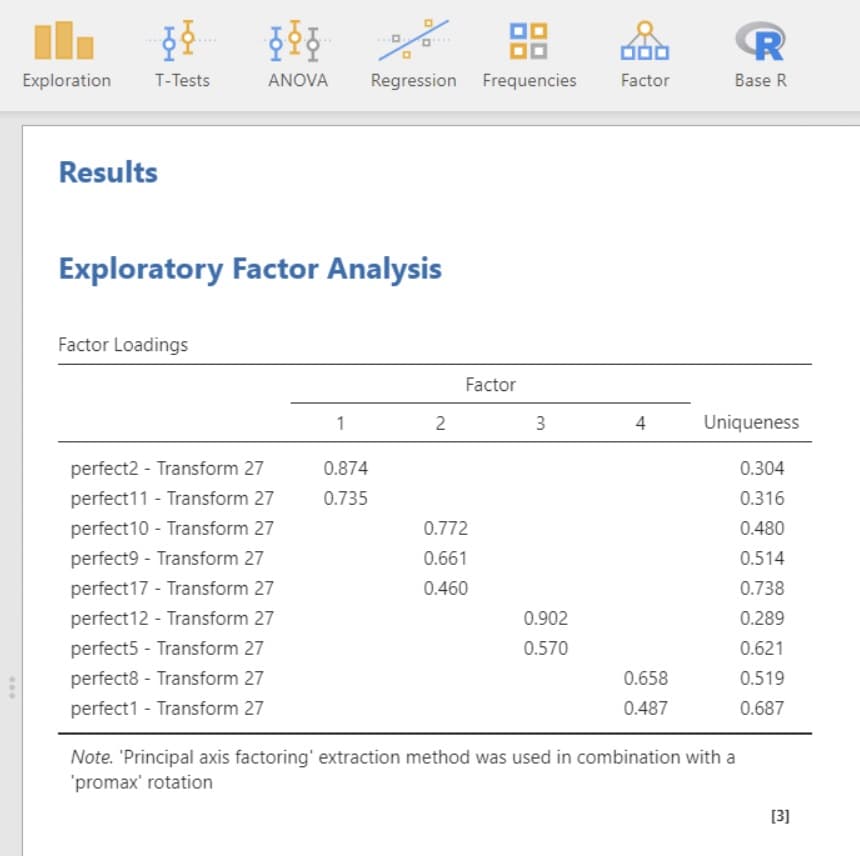
Exploratory Factor Analysis identified four distinct dimensions of perfectionism, together explaining 50.3% of total variance in the data:
- Organization and Orderliness
- Fear of Failure and Concern over Mistakes
- Task Completion and Timeliness
- Striving for Excellence and High Standards
Multiple Linear Regression then tested how these dimensions predict self-doubt. The model explained 13.6% of the variance in self-doubt — modest but statistically meaningful for a single-construct predictor set. Concern over Mistakes and Feelings of Failure were the significant predictors, with feelings of failure showing the stronger effect.
#Solution Architecture
This wasn't built as software — the analysis was run in jamovi (a GUI statistics package) directly on the survey dataset, not through a coding pipeline. The "architecture" here is the analysis workflow, not a system:
Raw survey data (perfectionism + self-doubt items)
  → Data screening (checked for suitability: sample size, missingness, distribution)
  → Exploratory Factor Analysis
      → Determine factor count, extract loadings
      → Interpret and label 4 latent factors (50.3% variance explained)
  → Multiple Linear Regression
      → Self-doubt regressed on the 4 factor scores
      → Identify significant predictors (Concern over Mistakes, Feelings of Failure)
  → Interpretation against existing perfectionism literature
Key methodological decisions:
- Factor analysis before regression, not straight to regression on raw items — the survey has many correlated items measuring overlapping constructs; regressing self-doubt directly on every raw item would produce an uninterpretable, multicollinear model. EFA first collapses those items into a small number of meaningful latent dimensions, so the regression coefficients that come out actually mean something.
- Reported the variance explained honestly, not just significance — 50.3% (EFA) and 13.6% (MLR) are stated plainly rather than only reporting which predictors were "significant." A model that explains 13.6% of variance is a real but modest effect, and the write-up treats it that way.
- Findings tied back to the literature, not presented in isolation — results are interpreted against existing perfectionism research (Frost, Hewitt & Flett, Flett & Hewitt), positioning the findings as a contribution to an existing theoretical conversation rather than a standalone number.
Documented limitations: convenience sampling limits generalizability; a cross-sectional design means the findings show correlation, not causation — the write-up is explicit that longitudinal or intervention studies would be needed to establish causal claims.
#Implications
Concern over mistakes and feelings of failure — not perfectionism broadly — appear to be the specific levers connected to self-doubt. That's a more actionable finding than "perfectionism causes self-doubt": it points toward interventions (e.g., cognitive-behavioral techniques) that target how people relate to their own mistakes and failures specifically, rather than trying to reduce perfectionism as an undifferentiated trait.